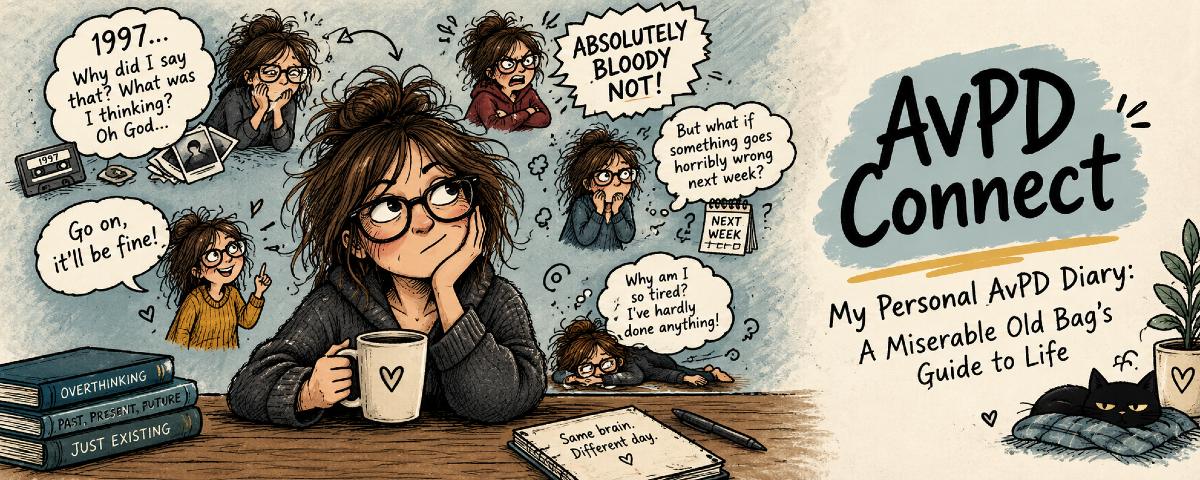

My almost total avoidance of people and reclusive lifestyle are largely driven by a deep fear of rejection and an extreme sensitivity to it.
My entire sense of self-worth is wrapped up in what other people think of me, which is rather inconvenient when your internal acceptance threshold is apparently set somewhere around, “Please give me a standing ovation or I shall assume you hate me.”
The Exhausting Business Of Being Human
I find conversation competitive, performative and bloody hard work. But then I have Avoidant Personality Disorder, which basically means I feel so worthless that every interaction feels like an audition.
And when someone talks at me – which, let’s face it, people do if they think they can get away with it – I’m not even actually listening because I’m too busy monitoring myself.
Do my arms look odd hanging by my sides, or should I put them in my pockets? Should I bend one leg to look more casual and less awkward? Have they noticed I haven’t actually listened to a word they’ve said? Am I nodding in the right places?
I’ve got absolutely no idea what they’re saying, but they’re enjoying themselves, so I’ll just nod along and try to get away as soon as I can without being rude.
The Appeal Of Retreating From The World
These interactions make me feel like utter rubbish, so years ago I decided to embrace a reclusive lifestyle.
(I go through phases of trying to put myself out there and you can read about that in my AvPD diary).
In the eyes of many people, I’m probably a sad and lonely character who’s wasting her life stuck at home most days, doing solo activities with just two rescue cats for company.
She’s lonely. She’s wasting her life. She needs to get out more. She needs to make friends. She needs to put herself out there.
If you happen to have Avoidant Personality Disorder (or even if you don’t), there’s a good chance you’ve heard some variation of the above.
But when you have this thing, it’s not as easy as that. And that’s one of the reasons some of us become reclusive.
Sometimes, being away from people isn’t depressing or sad. It’s a fucking relief.
Are We All Having As Much Fun As We Pretend?
Most of us are smart enough to realise that people’s social-media personas and lifestyle posts – endless happy gatherings, irritating perma-smiles whilst cooing over perfect dinners served at the latest trendy restaurants – are all a little bit… put together.
It’s how people should live, though, apparently. It’s a prime example of a successful, happy person living an acceptable life.
But are these people really having a ball, or do the photos lie? I often wonder if some of these sparkling, happy people would actually rather be at home, slobbed out, covered in cat fur, reading a good book with breadcrumbs in their bras.
Maybe they’ve seen the same happy-life posts and decided that they should be doing the same happy-life things to fit in, to actually be happy and to feel accepted and smiled upon.
And on and on it goes: people replicating what they’ve seen online and feeling that they wouldn’t be normal if they wanted to live a much more solitary life. There would be something wrong with them – or with that particular lifestyle.
I used to think the same, and it was depressing for me because of my extreme social anxiety and sensitivity to rejection.
Not Everyone Enjoys The Banter
And as I’ve already said, conversations seem combative and competitive to me. Everyone wants to be heard, myself included. I’m sure plenty of people have a great time bantering away with their friends, but I suspect just as many find it draining.
Introverts.
You Don’t Need AvPD To Prefer Solitude
Some people without AvPD choose to live reclusively because of the trials and tribulations of human relationships. Others, like myself, simply find conversation pointless and would much rather be left alone to get on with their own thing.
I’m happiest hanging out at home with my headphones on, dancing around like a lunatic to the Spice Girls while my cats look on with an expression of slight concern. I do my own thing and, after years of trying to live the way I thought I was supposed to, I’ve finally worked out which forms of connection actually work for me.
What The Research Says About Loneliness
And this is where things get interesting.
A 2026 global review of national policies across 194 WHO member states found that governments are beginning to develop strategies around loneliness, social isolation and social connection. But the researchers make an important distinction: loneliness is a subjective feeling, whereas social isolation refers to the objective absence of social contacts and relationships. The two aren’t necessarily the same thing. Someone can have very little social contact and not feel lonely, while someone surrounded by people can feel desperately lonely.
The Bare Minimum Of Bants
I often feel desperately lonely, but I’m never going to be one of those free and easy-going people who can bants back and forth with the best of them. And yes, I totally envy those people – but the self-hatred that grips me when I’m required to chat more than the odd sentence at a time just isn’t worth it for me. On the whole, I am happy living the way that I do.
The trick is to find which forms of connections work for you as an individual. I doubt many people could be content being totally alone. I have no next-of-kin or anyone who would know if I went missing – but I have a couple of online friends, plus I chat to the boat people near where I live, which helps me.
Who Decides What A Successful Life Looks Like?
So perhaps we need to be a little more careful about assuming that a person who lives alone, has few friends or avoids social situations is automatically living a failed or unhappy life.
Society still tends to treat an avoidant lifestyle as though it’s a character flaw rather than a coping mechanism and lifestyle choice shaped by our experiences. Why is one lifestyle rewarded so heavily? And why is a socially busy life so often treated as evidence that someone is happier, healthier or somehow doing life better?
Maybe the question shouldn’t always be, “How do we get this person to socialise more?”
Maybe sometimes it should be, “What kind of life does this person actually want?”
And what I want, what I really, really want, is for people to stop confusing a life they wouldn’t choose with a life nobody could possibly enjoy.
 Further Reading And Resources
Deconstructing Solitude and Its Links to Well-Being – This review argues that solitude is neither inherently beneficial nor harmful; its effects on wellbeing depend on factors such as how much time someone spends alone, whether it is chosen or imposed, and how they feel and think during that time.
Definitions of Solitude in Everyday Life – This research paper explores how solitude is defined and experienced, distinguishing chosen solitude from loneliness and unwanted isolation. It also questions assumptions about what makes time spent alone positive or negative.